
CORE MARKET: PRECISION OPTICS
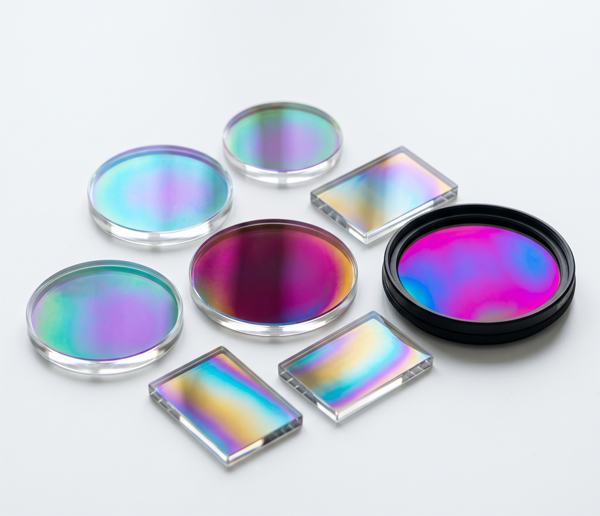
Precision Optical Filters & Specialty Optics
Tailored optical filters, micro-optics and specialised bulk components for demanding instruments and systems.
WHO WE SUPPORT
Optical filters and coated optics engineered around your instrument
Helia supports instrument and system builders whose products rely on precisely defined optical performance. We work with OEMs in medical, life-science, analytical, forensic and scientific instrumentation, where spectral response, substrate choice and component geometry are integral to the design.
Our capabilities include wafer-level filters, detector mosaics, micro-optics and specialised coated components for imaging, sensing and inspection systems. Where your product depends on a particular spectral shape, challenging substrate or custom optical architecture, we develop components designed to integrate reliably into manufacture.
The optical integration challenge
When a small optical component defines the whole instrument
In many instruments, critical optical performance is concentrated in just a few components: a filter edge defining channel separation, a coated prism directing the signal path, or a detector array with spectral regions integrated directly at wafer level. Because these components are closely tied to the instrument architecture, they cannot be changed without potentially affecting calibration, sensitivity, spectral discrimination or mechanical integration.
Spectral behaviour tailored to the application
We develop filters and coatings with defined edge positions, passbands and blocking performance, shaped around the optical function your instrument needs to achieve.
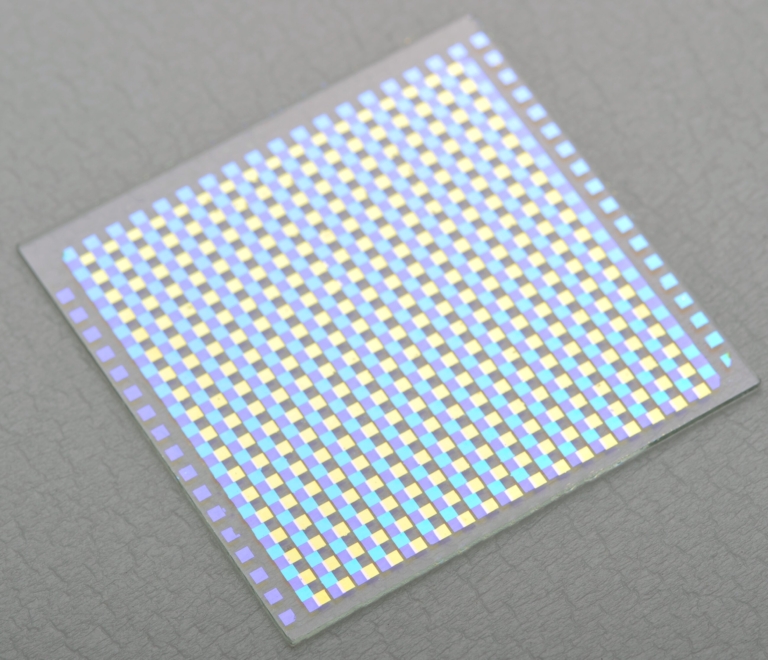
Wafer-level arrays and mosaic filters
For detectors and compact sensing architectures, we produce wafer-level filters, mosaic arrays and patterned spectral regions designed to align with the pixel, sensor and optical layout.
Micro-optics and complex optical geometries
Coated prisms, micro-structured optics and non-standard component shapes require coating processes that account for geometry, handling and integration from the outset.
Challenging substrates and wavelength ranges
Where an application requires materials such as CaF₂, ZnSe or silicon (or operates in unusual wavelength bands) we develop appropriate coating designs and process routes rather than relying on generic catalogue solutions.
Our solutions
Optical components designed around your instrument
Helia provides wafer-level filters, coated micro-optics and specialised bulk optics for instruments where optical performance cannot be left to a standard catalogue part. We develop solutions around your required spectral response, component geometry, substrate and manufacturing sequence, supporting reliable integration and repeatable production.
Wafer-level filters and detector mosaics
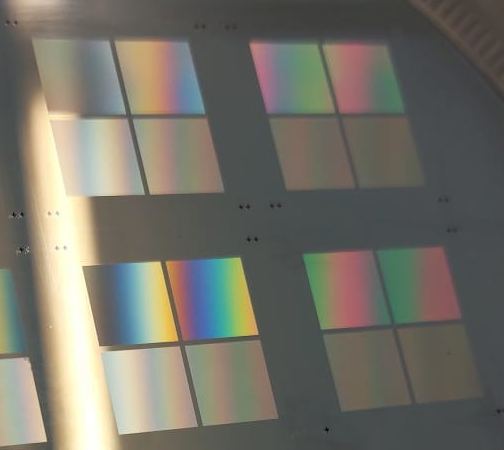
We process wafers that will become detector arrays by defining distinct regions through photolithography and depositing different filter stacks into those regions to create a mosaic of spectral responses across the array.
- Up to around fifteen separate deposition steps on a single wafer, each providing a different edge or bandpass function.
- Careful sequencing so that earlier coatings remain stable through later process steps and bake-outs.
- Thinning, dicing and final inspection carried out after the filter sequence is complete, reducing risk on fragile wafers.
This supports focal plane arrays and other detector architectures where each region of the wafer has to deliver a defined spectral window within the finished system.
Micro-optics and structured components
For wafers carrying microlenses, MEMS structures or other micro-optical features, we apply coatings to one or both sides and build the flow around the geometry and handling limits of the part.
- Designs that can combine mirror, beamsplitter, filter or AR functions across the component.
- Process flows developed to avoid damaging delicate surface relief or MEMS features.
- Measurement, dicing and inspection steps tailored to the scale and complexity of the structure.
The aim is not just to coat the part, but to make sure the coated micro-optic behaves consistently once assembled into the instrument.
Bulk optics for demanding instruments
We also support a focused set of customers needing specialised coated bulk optics for analytical, cryogenic, defence and sensing applications where the optic is small in size but significant in system impact.
- Cleaning and coating flows adapted to substrates from glass and silicon through CaF₂, ZnSe and other challenging materials.
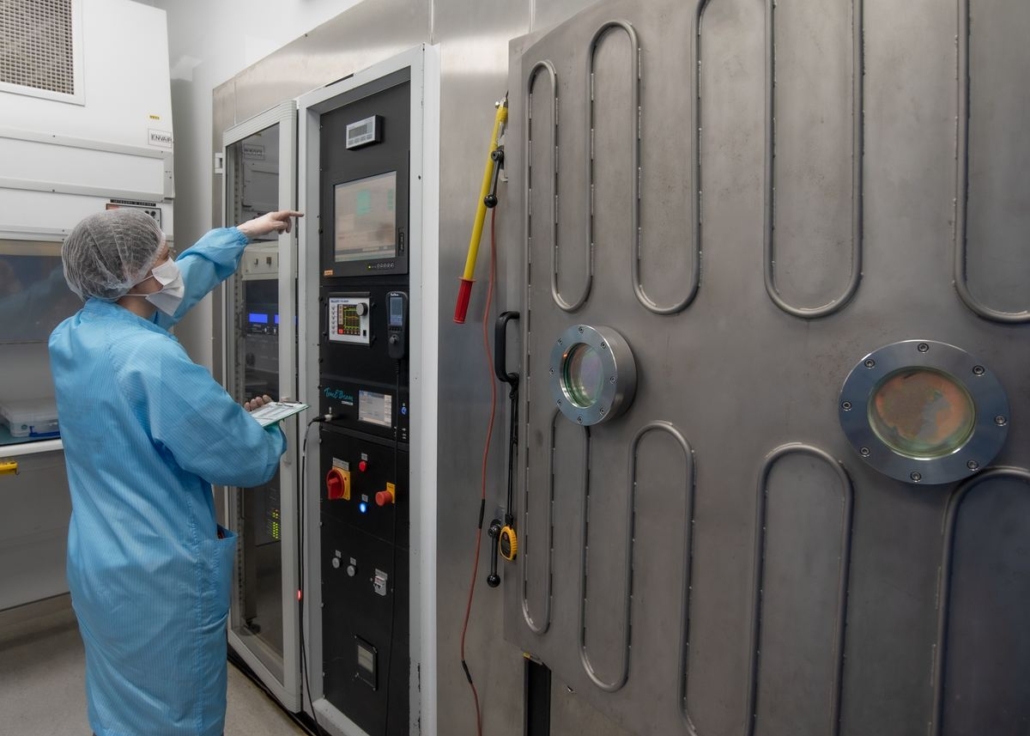
- Precision optical monitoring on selected systems for tight edge filters and more consistent spectral performance.
- Attention to the thermal, mechanical and environmental constraints of the finished instrument.
These parts are often deeply designed into the instrument, so stability, consistency and re-supply matter as much as the nominal spectrum.
How we work with you
From technical development to repeat production
Define the component requirement
We start from the role the optic plays in the instrument: spectral targets, blocking, edge position, substrate, geometry, handling constraints and operating environment.
Design the stack and process flow
We translate the target optical behaviour into a manufacturable design, taking into account sequencing, photolithography, coating compatibility and downstream processing.
Prototype and measure
Initial parts are produced and characterised so we can compare measured performance against the required spectral and physical behaviour.
Refine for the real instrument
We iterate where needed to improve fit with the system, whether that means spectral adjustment, process robustness, handling changes or tighter control of variation.
Lock down repeatable manufacture
Once the design is frozen, we establish a stable production route with the documentation, inspection and process control needed for ongoing supply.
Every successful solution starts with the right conversation
Whether you are developing a new product, scaling into production, or looking to improve yields, our engineers can help you identify the right coating strategy for your application.
Website
www.helia-photonics.com
Location
Livingston, Scotland.
FOLLOW US

Contact Us
Helia Photonics Ltd
Rosebank Technology Park
Livingston
West Lothian
Scotland, UK
EH54 7EJ
+44 (0)1506 414800